What Is Business Planning? How Executives Turn Direction Into Coordinated Action
Business planning answers what the organization will pursue and how
Business planning is the process of defining your organization’s goals and the strategies intended to achieve them. It gives executives a structured way to decide what the organization will pursue, what it will treat as a priority, and how its teams will contribute to that direction.
Business planning is more useful when you treat it as an active leadership discipline rather than a document produced once and stored away. The work connects direction with choices. It asks you to move from broad ambition to a manageable set of priorities, assign responsibility for action, and decide how progress will be observed.
Business planning answers two connected questions:
- What will the organization pursue? This includes purpose, direction, goals, priorities, and the strategic issues that require attention.
- How will the organization move toward it? This includes strategies, responsibilities, resources, timelines, measures, and the decisions that keep execution connected to the chosen direction.
The answers do not need to predict every condition your organization may face. They need to give your leadership team a shared basis for choosing among competing demands. When priorities are unclear, each function can make a reasonable decision that still pulls the organization in a different direction. When priorities are explicit, you have a reference point for deciding what belongs on the agenda and what can wait.
That distinction matters most when your organization has multiple teams, functions, or business units. Growth creates more decisions, more dependencies, and more opportunities for effort to spread across competing initiatives. Business planning gives you a way to bring those choices into one conversation before they become disconnected operating decisions.
The planning activity is different from the business plan
Business planning is the work of setting goals and strategies; a business plan is the resulting reference that can serve as a roadmap for the company. The planning activity involves discussion, judgment, tradeoffs, and decisions. The plan records enough of those decisions for your leadership team to use them after the planning conversation ends.
A document can be clear and still fail to guide action if the people responsible for execution do not understand the choices behind it.
Use the distinction this way:
- Planning is the activity. You examine your direction, define goals, choose strategies, identify issues, and decide how work will move forward.
- The plan is the shared reference. You capture the selected direction, priorities, actions, responsibilities, and measures in a form your team can revisit.
- Management keeps the reference useful. You compare progress with the direction, discuss material changes, and adjust when the original choice no longer fits the conditions.
A business plan therefore should not be treated as a substitute for executive judgment. It gives your organization a common reference, but your leadership team still has to interpret new information and make decisions. A plan that never returns to the operating conversation can become outdated instead of serving as an evolving guide. Treat the document as a decision aid, not as evidence that the planning work is finished.
The practical test is simple: can you use the plan to explain what matters now, who owns the next action, and how the leadership team will recognize movement? If the answer is no, return to the planning activity rather than adding more pages.
Why growth makes planning more consequential
Growth makes business planning more consequential because direction has to travel through more parts of the organization. An executive team may agree on a goal, yet sales, operations, finance, technology, and people leaders can interpret that goal differently unless the organization connects it to coordinated work.
Strategic alignment links an organization’s mission, vision, and objectives to efforts across teams and departments. Strategic planning can also connect leadership priorities with execution at business-unit and operational levels. Those connections give you a way to examine whether daily and departmental choices support the direction the leadership team has selected.
Growth usually changes the planning question from “What should we do next?” to a broader set of questions:
- Which goals deserve organization-wide attention?
- Which initiatives depend on work from another team?
- Which resources are already committed elsewhere?
- Which decisions should remain with executives, and which can move closer to the work?
- How will each function recognize its contribution to the shared direction?
Business planning does not remove those tradeoffs. It makes them discussable. Without a shared set of priorities, a growing organization can accumulate projects that each appear reasonable in isolation. Strategic planning can help focus investment choices and avoid initiatives that do not support long-term goals, but that benefit depends on making the connection between the goal and the investment explicit.
You can see the need for more planning discipline when teams use different definitions of success, executives revisit the same priority without resolving ownership, or important work competes for the same people and resources. Those signs do not tell you which strategy to choose. They tell you that the organization needs a clearer process for choosing and coordinating its work.
First clarify the direction the organization is choosing
A planning process may clarify your organization’s purpose, values, vision, competitive advantages, strategies, and the strategic issues it needs to address. These areas give your leadership team the language needed to describe the direction before it assigns projects or measures.
Start with meaning, not activity. A list of current projects tells you what people are doing; it does not necessarily explain why those activities deserve continued attention. Direction-setting asks you to identify the intended destination and the choices that distinguish that destination from every other possible use of time, money, and leadership attention.
Use the following questions to make the direction concrete:
- Purpose: What does your organization exist to do, and for whom?
- Vision: What would meaningful progress look like over the planning horizon?
- Values: Which principles should guide decisions when goals compete?
- Advantages: Which strengths or capabilities does your organization intend to build on?
- Strategic issues: Which conditions, decisions, or obstacles require executive attention?
- Strategies: Which broad approaches will connect the organization’s present position with its chosen direction?
These questions are not a mandatory sequence or a complete planning framework. They are a way to test whether your leadership team is discussing direction at the right level. If the conversation jumps straight to departmental tasks, pause and identify the organizational choice that those tasks are meant to support.
Clear direction also gives later priorities a reason to exist. A goal should not appear on the plan merely because it is familiar, urgent, or owned by an influential function. Your team should be able to explain how the goal relates to the direction it has chosen. That explanation is the bridge from purpose to execution.
Turn direction into a limited set of measurable priorities
Strategic goals and objectives should be clear and measurable, with progress indicators that help your organization see whether movement is occurring. A limited set of priorities gives your leadership team a basis for deciding where attention and investment should go instead of treating every desirable initiative as equally urgent.
A useful priority does more than name an aspiration. It tells you what will change, how you will recognize progress, and why the change supports the organization’s direction. The selected planning guidance describes goals and objectives as specific, measurable, achievable, relevant, and time-bound. Use those qualities as a test rather than as a reason to turn every priority into a measurement exercise.
Review each proposed priority with five questions:
- What will change? State the intended result in language that different teams can interpret consistently.
- How will progress be observed? Identify a measure or progress indicator that relates to the objective.
- Is the priority achievable with the resources available? A goal that ignores capacity creates a commitment without an execution path.
- Why does the priority matter to the chosen direction? Connect the objective to purpose, vision, or a strategic issue.
- When will you review it? A time boundary gives the leadership team a point at which to assess movement and make a decision.
The point is not to create a long scorecard. Strategic planning can help organizations focus investment choices and avoid initiatives that do not support long-term goals. Your leadership team therefore has to make tradeoffs visible: if a new priority enters the plan, decide what receives less attention, a later timeline, or a different resource commitment.
Measurable priorities also make conversation more precise. Instead of asking whether the organization is “making progress,” you can ask what changed, what remains blocked, and whether the selected approach still fits the direction.
Make priorities executable across teams and resources
Action plans can specify the steps needed to achieve strategic objectives, assign responsibilities, set timelines, and establish performance metrics. This is the point at which business planning moves from a leadership choice to coordinated work across the organization.
Your plan should make the handoff from executive direction to team execution visible. For each significant priority, identify the work that must occur, the person or team responsible for moving it forward, the timing that matters, and the measure that will be reviewed. Responsibility does not mean that one person performs every task. It means that someone has the authority and obligation to keep the work moving across its dependencies.
Effective strategy also requires allocating financial, human, and technological resources to strategic initiatives. Resource allocation is therefore part of planning, not a later administrative exercise. If your organization names a priority without considering the people, funding, systems, or time required, the plan has recorded an intention rather than a workable commitment.
Ask these execution questions before you finalize a priority:
- Which teams must contribute for the priority to move?
- What work must happen first, and what work depends on it?
- Who owns the decision when teams disagree about timing or scope?
- Which financial, human, or technological resources must be assigned?
- What performance measure will the leadership team review?
- What should stop, slow down, or change so the priority has room to proceed?
Strategic alignment links mission, vision, and objectives to work across teams and departments. Your job as an executive is to make that link observable. If a department cannot explain how its assigned work supports an organizational priority, revisit the translation between the two levels rather than assuming the department is misaligned.
Place business planning within the wider planning system
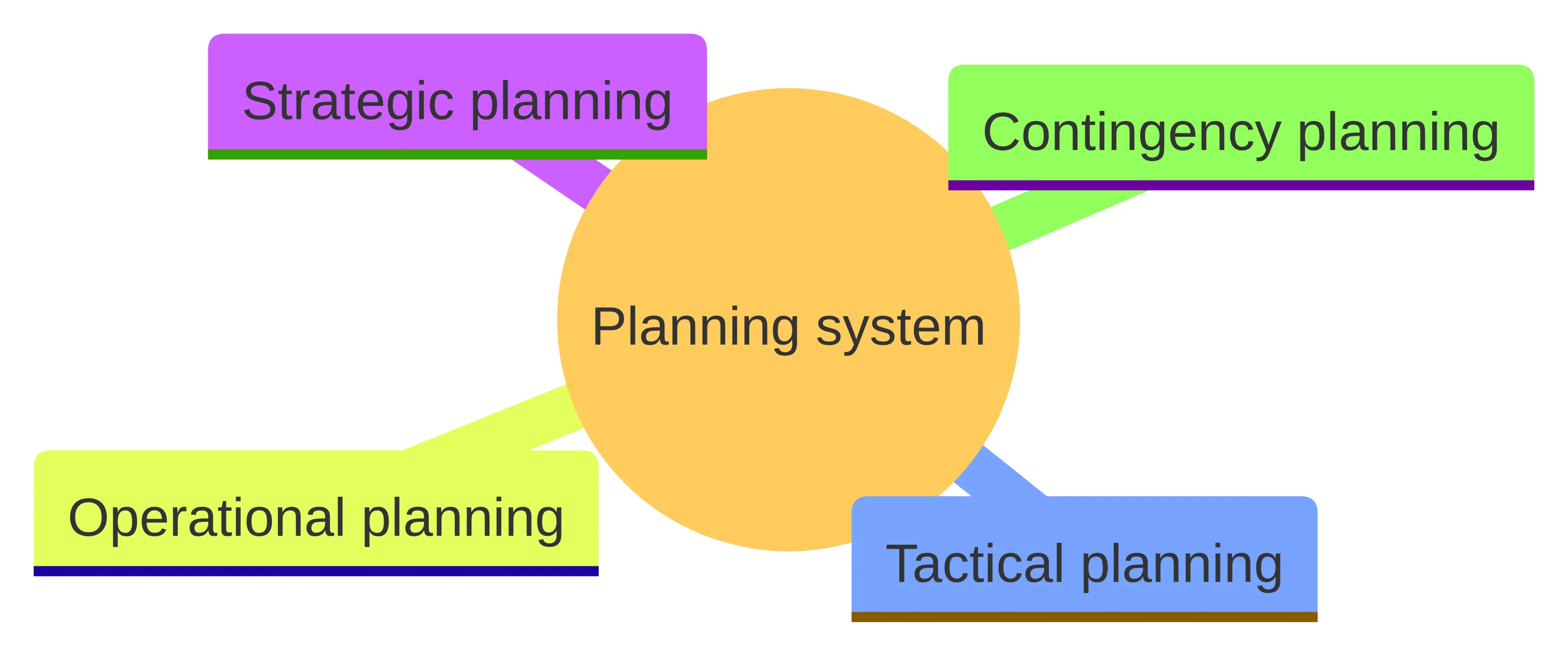
Organizational planning can include strategic, tactical, operational, and contingency planning. Business planning becomes easier to understand when you distinguish the level of decision each type addresses instead of treating every plan as interchangeable.
- Strategic planning addresses long-range goals, mission, vision, competitive direction, and multi-year priorities. It asks where the organization is going and which broad choices will guide it.
- Tactical planning translates those choices into department-level approaches. It asks how a function or business unit will contribute to the selected priorities.
- Operational planning addresses the workflows, schedules, and near-term actions required to carry out the work.
- Contingency planning considers how the organization will respond when a material condition changes or an expected path becomes unavailable.
These categories describe connected layers rather than isolated exercises. Strategic planning can establish direction; tactical and operational planning can translate that direction into work; contingency planning can prepare the organization to revisit its choices when conditions require it. The planning process may also clarify purpose, values, vision, competitive advantages, strategies, and strategic issues before those layers are assigned to teams.
Use the distinction to find the gap in your current planning effort. If your leadership team debates long-range direction without identifying departmental implications, the tactical connection needs attention. If teams have detailed workflows but cannot explain which organizational priority those workflows support, the strategic connection needs attention. If your plan assumes that conditions will remain fixed, discuss the decisions that would trigger a review.
You do not need to force every planning activity into one document. You do need a clear relationship between the layers. Organizational planning connects where the company is going with how every level of the company will get there. That relationship is what allows direction to remain visible as work becomes more specific.
Review the plan so it can guide course correction
Monitoring and evaluation help your organization determine whether its strategy remains on track and make adjustments when needed. Review is not an admission that the original plan was defective; it is the management activity that keeps the plan connected to changing conditions and actual execution.
A plan without ongoing management can become outdated instead of serving as an evolving guide. Your leadership team should therefore decide in advance what information will return to the planning conversation, who will bring it, and which changes require a decision rather than a status update.
Use a recurring review conversation built around four questions:
- What has changed? Identify changes in performance, resources, priorities, dependencies, or operating conditions that affect the plan.
- What is moving? Review the progress indicators connected to the objectives rather than relying on general confidence.
- What is blocked? Name the obstacle, the decision required, and the owner responsible for the next action.
- What should change? Decide whether to continue the approach, adjust the action plan, reallocate resources, or revisit the objective itself.
The review should produce a decision or a clearly assigned next step. A meeting that only repeats the plan does not help you manage it. Likewise, changing priorities without recording why the change occurred makes it harder for teams to coordinate their work.
Course correction should preserve the distinction between direction and method. You may need to alter an action, timeline, or resource assignment while keeping the broader objective intact. In another situation, new information may require a deeper discussion of the objective or strategy. Your review process should give the leadership team room to make either decision.
Use an executive test to decide whether planning needs more discipline now
An executive planning test should examine whether your organization can connect direction, priorities, resources, ownership, and review. The test is not a score or a universal standard. It is a disciplined way to identify where decisions are losing their connection as the organization grows.
Ask your leadership team:
- Can you state the organization’s current direction in terms that different teams understand in the same way?
- Can you name the limited priorities that deserve attention before other desirable work?
- Can each priority be expressed as a clear objective with a progress indicator?
- Can you identify the teams, responsibilities, timelines, and resources attached to each priority?
- Can department leaders explain how their work supports the organization’s mission, vision, or objectives?
- Can you identify the information that will cause the leadership team to adjust the plan?
- Can you distinguish an obstacle that requires action from a result that requires a change in strategy?
Strategic alignment links mission, vision, and objectives to efforts across teams and departments. Action plans can assign responsibilities, set timelines, and establish performance metrics. Resource allocation connects strategic initiatives with financial, human, and technological capacity. These three ideas give you a practical basis for examining the quality of your planning conversation.
If your answers are clear, use the planning process to maintain coordination and revisit decisions as conditions change. If several answers are unclear, start with the weakest connection rather than attempting to rebuild every planning layer at once. Clarify the direction if teams disagree about purpose. Narrow the priorities if everything appears urgent. Assign ownership if work is stalled between functions. Set a review point if the plan has no way to guide course correction.
The result of this test is not a label for your organization. It is a choice about the next planning action that will improve clarity.
What a useful planning effort should leave behind
A useful business planning effort should leave your organization with a clear direction, a limited set of measurable priorities, an execution path, visible ownership, resource choices, and a way to review progress. The plan should help you explain what the organization will pursue, why it matters, how teams will contribute, and when leadership will reconsider the approach.
Business planning is therefore more than the production of a business plan. It is the disciplined work of turning direction into coordinated choices and keeping those choices connected to execution. The resulting plan can serve as a roadmap, while ongoing management gives your team a basis for course correction when necessary.
At MAP Consulting, we treat a business plan as a company roadmap that can support course correction when necessary. For decisions involving your organization’s specific financial, legal, or operating conditions, consult a qualified professional who can assess those circumstances directly.
Use your next leadership discussion to answer one practical question: which connection needs attention first—direction, priorities, resources, ownership, or review? The answer gives you a focused starting point for bringing greater discipline to business planning.
