What Is MAP Consulting? Services, Management System, and Organizational Fit
What MAP Consulting Refers To
Your question is probably more practical than a name check. You want to know whether MAP Consulting works on the type of leadership, accountability, planning, or execution problem facing your organization. The useful way to evaluate the organization is to separate four layers: what MAP is, what it offers, how its management approach is described, and what you would need to ask before deciding that the fit is right.
This article uses MAP to mean Management Action Programs (MAP). It does not use the name for RoadMap Consulting, Maps Management & Consulting, MAP tests, MAP certification, or another organization with a similar label. If your search concerns one of those subjects, the explanation here is not the relevant overview.
The central question is not whether a management system sounds organized. It is whether the stated emphasis on goals, alignment, accountability, and execution matches the management challenge you need to address. That distinction keeps you from treating a general description as a promise about your organization.
The Organizational Problems MAP Consulting Says It Addresses
MAP Consulting also describes the MAP Management System as driving execution and accountability. In practical terms, that places follow-through beside strategy rather than treating strategy as a document that ends after approval. You can use this distinction when assessing your own situation: ask where commitments lose ownership, where progress becomes difficult to see, and where decisions fail to reach the people responsible for acting on them.
Your organization may be exploring this type of support if several of these conditions are present at the same time:
- Leaders agree on broad priorities, but teams interpret them differently.
- Meetings produce commitments that are difficult to track after the meeting ends.
- Managers spend time reacting to urgent issues because planned work has no clear follow-through.
- Growth has increased coordination demands without creating a shared management rhythm.
- Senior leaders cannot easily connect daily activity with the goals they want the organization to achieve.
These are decision prompts, not a diagnosis. The presence of one symptom does not tell you which service or approach would fit.
The stated approach connects organizational goals with key strategies. That makes this approach potentially relevant when your main question concerns coordinated execution rather than a narrow technical task. You still need to define the business problem in concrete terms before judging whether the approach matches it.
What Management Consulting Means in This Context
Management consulting is a broad category in the United States. It can cover organizational planning and design, human-resources planning, corporate strategy, technology strategy, marketing and sales, financial planning and budgeting, and logistics for businesses, nonprofits, and public-sector agencies. The category describes the type of work a consulting practice may address; it does not tell you what every firm delivers.
MAP Consulting places its approach within that broad category through customized consulting and an accountability process for executing Vital Factors Goals. That combination is narrower than the full management-consulting field. It directs your attention toward organizational goals, leadership, alignment, and execution rather than assuming that every possible consulting discipline is part of the engagement.
For an executive, the distinction changes the questions you ask. Instead of asking only whether MAP Consulting is a management consulting firm, ask what decision or operating problem you want outside support to address. Examples include:
- translating a strategic priority into goals that different functions can use;
- clarifying who owns a commitment and how progress will be discussed;
- developing leadership capability as the organization adds management layers; or
- creating a business plan that gives the organization a shared direction.
The first two areas align directly with the stated MAP Management System. The latter areas require a more specific conversation about the intended offering, participants, and working conditions.
A category label cannot determine fit for you. A service can be relevant to an organization with several departments and still be poorly matched to a narrowly defined problem, an unavailable leadership team, or a need outside the described focus. Treat the category as an orientation point, then compare your objective with the work MAP Consulting actually proposes.
The MAP Management System at a High Level
The MAP Management System is described as a business-management solution that combines customized consulting with an accountability process for executing Vital Factors Goals. The wording gives you two connected parts to examine: the goals and strategies that define direction, and the accountability process intended to support execution.
MAP Consulting describes the system as helping identify organizational goals that align with key strategies. That connection is the difference between naming an aspiration and defining what the organization must move toward. When you assess the approach, look for a clear relationship between the strategic priority, the goal that represents progress, and the people who must act on it.
The same system is described as driving execution and accountability. Accountability here should be read as part of the operating approach, not as a promise that every commitment will be completed. Your assessment should focus on how responsibilities, progress, obstacles, and decisions would be made visible in the proposed work.
MAP Consulting connects the system with focus and alignment and describes it as a way to execute Vital Factors Goals. A reasonable way to interpret that description is as a management structure for keeping strategic priorities connected to follow-through.
Use these questions to keep the high-level explanation concrete:
- Which organizational goal would the work address first?
- How would that goal relate to the strategy already approved by leadership?
- What would count as visible progress?
- Who would own the work between formal discussions?
- How would unresolved barriers return to the leadership team for a decision?
The answers will tell you more about practical fit than the name of the system alone.
How Goals Become a Company Roadmap
MAP Consulting describes the MAP Management System as helping develop a business plan that serves as a roadmap for a company. A roadmap is useful when it gives people more than a destination. It should make the direction understandable enough for leaders to connect decisions, priorities, and operating work.
A strategy map can visually connect strategic objectives with day-to-day operations so that organizational actions contribute to broader goals. It can also give leaders and employees a shared understanding of strategic direction by showing how goals and processes relate. Those are general features of strategy maps, not a claim that MAP Consulting uses a particular map format.
Strategy maps can translate broad organizational goals into specific, measurable, achievable, relevant, and time-bound objectives and actionable steps. That gives you a useful test for any roadmap conversation: can you explain what must happen, how progress will be recognized, and which actions belong to which part of the organization?
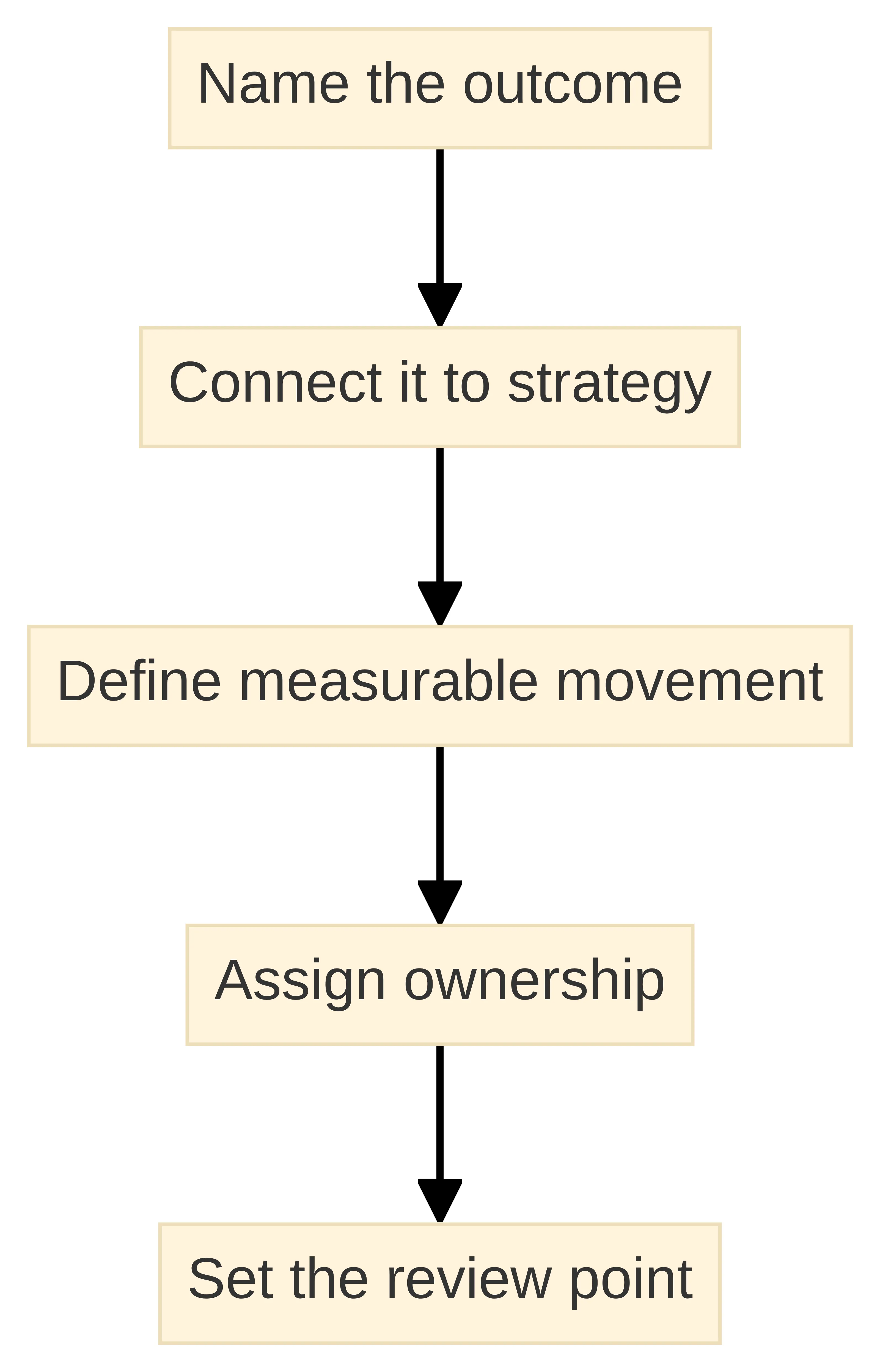
You can examine a proposed roadmap in this sequence:
- Name the outcome. State the organizational result in plain language rather than using a general ambition such as improve performance.
- Connect it to strategy. Identify the strategic priority that makes the outcome worth pursuing.
- Define measurable movement. Choose indicators that show whether activity is moving toward the goal. These may include operational, financial, customer, or people measures, depending on the objective.
- Assign ownership. Make clear which leader or team has responsibility for the next action.
- Set the review point. Decide when progress, obstacles, and changed conditions will be discussed.
This sequence is a practical evaluation tool. It does not establish that a particular engagement will use these exact steps.
The value of a roadmap is not its visual appearance. Its value is the connection between what leadership wants, what teams do, and how the organization recognizes movement. If those links remain unclear, a plan can exist without becoming a useful management instrument.
The Offerings a Prospective Buyer Should Investigate
Our MAP Management System uses an accountability process to execute Vital Factors Goals. If your main concern is strategic execution, ask how that consulting would be tailored to your organization, which leaders would participate, and what work would continue between formal sessions.
Our MAP Program is a 2.5-day, in-person leadership and management workshop. That format matters because it is different from an ongoing consulting engagement or an individual coaching arrangement. If a workshop is the option under consideration, determine which leaders should attend, what organizational question the group would bring into the room, and how the work would connect to decisions after the session.
Ask what organizational objective the consulting would address and what work would continue between formal sessions.
- Leadership and management training: The MAP Program is a 2.5-day, in-person workshop. Ask whether its format matches the number, roles, and availability of the participants you want involved.
- Executive coaching: MAP Consulting offers executive coaching. Ask whether your need concerns an individual leader, a leadership team, or a broader operating system, and what type of engagement is available.
- Business planning: The MAP Management System helps identify organizational goals aligned with key strategies and develop a business plan that serves as a company roadmap. Ask how that plan would connect with the goals and roadmap your organization already uses.
- Digital solutions: MAP Consulting offers digital solutions. Ask what problem the digital option is intended to support and how it would relate to the management practices you want to establish.
These descriptions do not establish a specific format, price, feature set, or outcome.
Choose the inquiry path that matches the problem you can name. If the problem is shared direction and follow-through, begin with the management-system and consulting questions. If the problem is concentrated in leadership capability, investigate the workshop or coaching route. If the problem is planning, ask how the plan would become an operating roadmap rather than a document kept apart from daily decisions.
Before moving forward, clarify the conditions that affect fit: delivery format, participant roles, time commitment, leadership involvement, expected outputs, and how progress would be discussed. Those conditions are not minor administrative details. They determine whether your organization can use the proposed work in practice.
What a Service Description Can—and Cannot—Tell You
A service description can clarify identity, focus, and stated offerings. They do not tell you that the approach will produce a particular revenue change, solve every accountability problem, or suit every leadership team. They also do not establish a result for your organization merely because another organization is described as having used the system.
You still need specific information about the proposed engagement, including its scope, participants, timing, responsibilities, outputs, and measures of progress. You need that information because a broad management description cannot answer an organization-specific fit question by itself.
MAP Consulting’s Presidential Award recognizes leaders for dedication to leading themselves, their teams, and their organizations, and it highlights team success in using the MAP Management System to achieve what we call breakthrough results. That recognition describes the purpose of the award and the results language used for those highlighted teams. It is not a forecast for your organization and should not replace a direct discussion of your objectives and conditions.
Read every business claim at the level at which it is made. A statement about what MAP Consulting offers is not a general rule about management. A statement about a system’s intended function is not a guarantee of an outcome. Keeping those boundaries clear gives you a more useful basis for deciding whether to explore the work.
Questions to Use Before Exploring MAP Consulting
A focused conversation begins with your organizational question, not with a request for every available service. Write down the answer to these questions before you contact MAP Consulting:
- What must change? Describe the execution, accountability, leadership, planning, or alignment problem in observable terms.
- Why does it matter now? Connect the problem to a strategic priority, operating decision, or organizational transition.
- Who needs to participate? Identify the leaders, managers, supervisors, or teams whose decisions and follow-through affect the issue.
- What would progress look like? Name the measurable or observable movement that would tell you the work is addressing the right problem.
- Which form of support fits the situation? Separate customized consulting, an in-person workshop, coaching, planning support, and digital support instead of treating them as one interchangeable service.
- What must happen between formal sessions? Ask how ownership, actions, obstacles, and decisions would be handled in the operating work.
- What would make the engagement a poor fit? State the conditions you cannot meet, such as unavailable participants, an undefined objective, or a need outside the described focus.
The goal question deserves special attention because MAP Consulting describes its system as helping identify goals aligned with key strategies and develop a business plan that serves as a roadmap. Ask for a direct connection between your stated objective and the work being proposed. If that connection is vague, the conversation is not ready for a fit decision.
The accountability question also needs a concrete answer. The MAP Management System is described as combining customized consulting with an accountability process for executing Vital Factors Goals and as driving execution and accountability. Ask what your leaders would own, what would be reviewed, and how the organization would handle a commitment that is delayed or changed.
Keep the answers in a short decision brief. Include the organizational objective, the leaders involved, the action you want to improve, the measure you will watch, and the conditions the engagement must meet. That brief gives you a disciplined basis for comparing the proposed work with the problem you brought forward.
Keep the Identity Clear When Researching
A simple identity check can keep your notes organized:
- Record the full organization name before collecting service information.
- Separate pages about Management Action Programs (MAP) from pages about MAP tests, MAP certification, RoadMap Consulting, or Maps Management & Consulting.
- Treat a general explanation of management consulting as category background, not as a description of every MAP Consulting service.
- Match each service reference to the problem it appears designed to address.
- Keep general management advice separate from statements about what MAP Consulting offers or how its system is described.
The purpose of this discipline is not to make the search complicated. It is to keep identity, service, and fit as three separate questions. You first need to know which organization you are examining. Then you can determine what work is described. Only after that can you judge whether the work relates to your own leadership and execution challenge.
Do not infer a service, delivery format, or outcome from the name MAP Management System alone. Your next questions should remain within those subjects unless MAP (Management Action Programs, Inc.) gives you a more specific description of another offering.
Once the identity is clear, return to your decision brief. The strongest next conversation will be the one that connects your named objective to a defined form of support, the leaders who need to participate, and the way progress would be recognized.
Choose the Next Information Step
MAP Consulting is relevant to explore when your organization is assessing support for leadership, accountability, planning, or execution. Its described options include customized consulting, executive coaching, training such as the 2.5-day, in-person MAP Program, business planning, and digital solutions.
Use your written objective and questions to request further information from MAP Consulting. Keep the conversation specific: name the problem, identify the people involved, describe the progress you need to see, and ask which form of support addresses that situation. A qualified professional must decide whether any individual engagement suits your organization’s circumstances.
What Should an Executive Verify Before Contacting MAP Consulting?
What services does MAP Consulting offer?
MAP Consulting provides a range of services including business planning, onsite training, executive coaching, team building, customized leadership development, and digital solutions.
How does the MAP Management System support organizational growth?
The MAP Management System is designed to provide focus, alignment, and accountability, helping organizations translate strategic goals into actionable plans and ensuring that execution aligns with those goals.
What is the MAP Program?
The MAP Program is a 2.5-day, in-person leadership and management workshop aimed at developing leadership skills and enhancing management effectiveness.
How can I determine if MAP Consulting is a good fit for my organization?
To assess fit, clarify your organization’s specific challenges related to leadership, accountability, and execution, and compare those needs with the services and approach offered by MAP Consulting.
What distinguishes MAP Consulting from other management consulting firms?
MAP Consulting differentiates itself through its focus on customized consulting combined with an accountability process for executing Vital Factors Goals, emphasizing practical, measurable outcomes.
What should I consider before engaging with MAP Consulting?
Consider the specific organizational objectives you want to address, the roles of participants in the engagement, and how progress will be tracked and discussed throughout the process.
