What Is an Entrepreneurial Operating System? A Practical Fit Guide for Growing Businesses
The real question is how work gets executed
A growing company can have a clear goal and still struggle to turn that goal into coordinated action. You may know the direction, discuss it in leadership meetings, and communicate it to your team, yet daily decisions still depend on whoever notices a problem first. Priorities shift, ownership becomes vague, and unresolved issues return in a different form.
EOS is a complete set of concepts and practical tools that small and midsize businesses use to standardize how they operate. It is designed to help leadership teams align on a shared vision, build accountability, and execute with discipline. The useful question for you is not whether a particular system has an appealing name. Ask what management infrastructure it creates: how direction becomes priorities, how priorities receive owners, how progress is reviewed, and how problems are resolved.
That distinction keeps the conversation practical. A management system does not replace judgment, leadership, or the need to make difficult decisions. It gives those decisions a repeatable place in the way your company operates. This guide explains the structure to look for, the trade-offs to weigh, and the questions to answer before you investigate a system.
An entrepreneurial operating system is management infrastructure
An entrepreneurial operating system is a coordinated set of practical management concepts and tools that gives a business a consistent way to work. In the documented EOS model, the purpose is to standardize operations while helping leadership teams align around a shared vision, establish accountability, and execute with discipline.
Think of management infrastructure as the connective layer between intention and execution. It should help you answer questions such as:
- What direction are we pursuing, and what does it mean for the company?
- Which priorities deserve attention now?
- Who owns each commitment, and what will show whether it is moving?
- Where will leadership review progress and decide what happens next?
- How will the team surface and resolve obstacles instead of carrying them forward?
The exact tools can vary, but the management job remains recognizable. Direction must reach daily work, and daily work must produce information leaders can use.
This is broader than adding another planning document or scheduling a meeting. A document can describe the destination. A meeting can create a moment of alignment. Infrastructure connects those activities to ownership, measures, recurring review, and corrective decisions. If those connections are absent, your company may have plans without a dependable operating rhythm.
The system connects six parts of the business
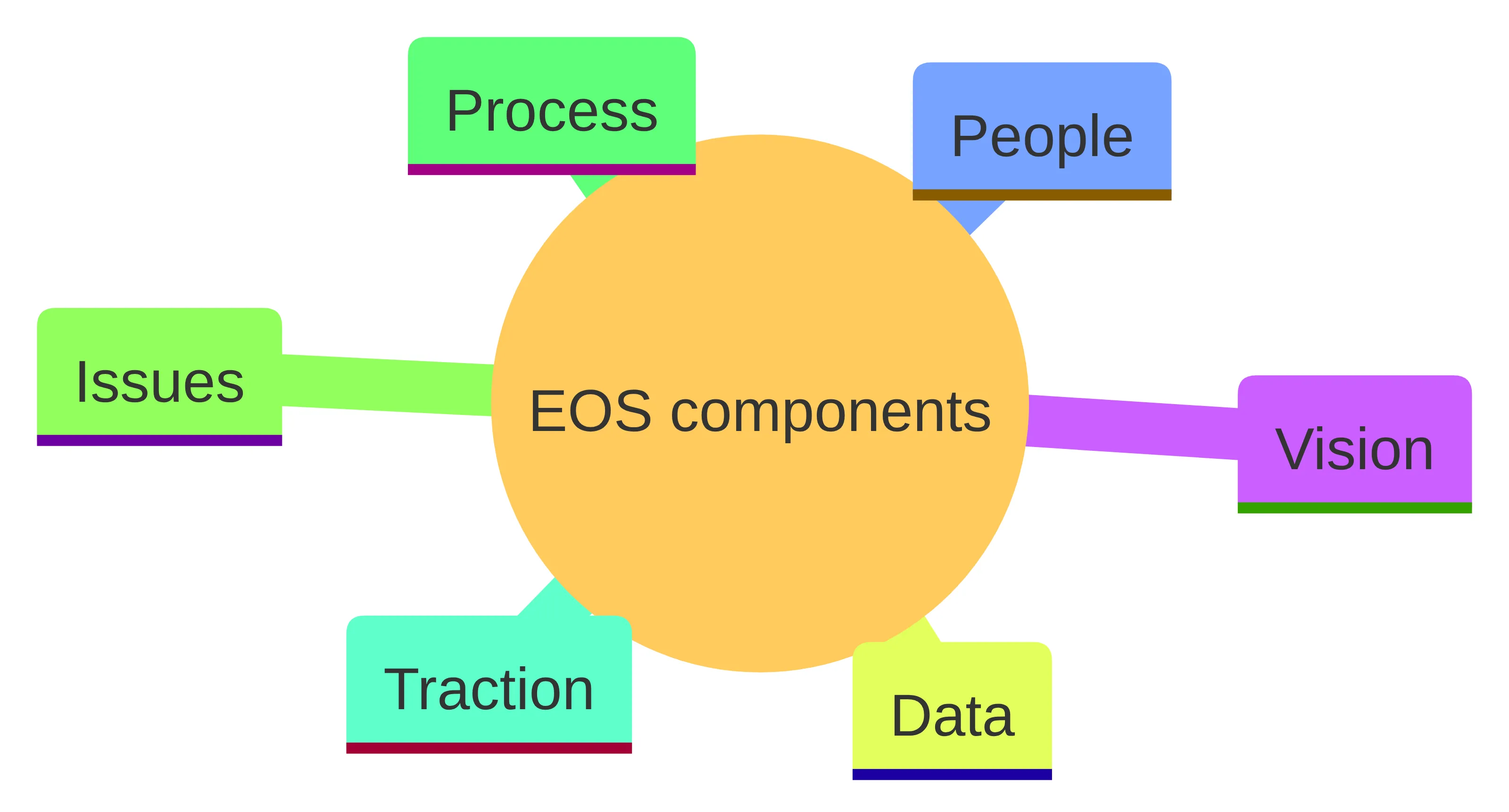
EOS covers six key components of a business: Vision, People, Data, Issues, Process, and Traction. EOS is presented as a whole operating system that covers all six rather than a framework focused on only one area. You can use those labels as a practical inspection map, even when you are comparing systems that use different terminology.
Use each component to ask a different management question:
- Vision: What future, direction, and priorities are guiding decisions?
- People: Do responsibilities and roles support the work the company needs to perform?
- Data: Which measures give leadership a shared view of performance and movement?
- Issues: Which obstacles, opportunities, and decisions require attention rather than avoidance?
- Process: Which repeatable ways of working should the team follow consistently?
- Traction: How does the organization turn direction into commitments, follow-through, and review?
The value of the map is in the connection between parts. A vision without ownership may remain an aspiration. Ownership without useful measures can leave you relying on impressions. Measures without a process may show a problem without showing how work should change. A system brings these questions into one management conversation instead of treating them as separate initiatives.
Do not treat the six labels as a scorecard that produces an automatic answer. Use them to examine where execution breaks down. If priorities are clear but issues stay unresolved, the gap may sit in the management rhythm. If meetings are active but responsibilities remain unclear, the gap may sit in ownership. Your assessment should follow the actual handoff from direction to work.
Execution becomes a recurring management rhythm
A management system becomes visible in the rhythm it creates. EOS is described as providing an operational structure for running meetings, setting agendas, and tracking tasks and responsibilities. Its Issues Component addresses how teams identify, discuss, and resolve obstacles, opportunities, and decisions that arise each week.
EOS uses IDS—Identify, Discuss, Solve—to work through an Issues list systematically during weekly meetings. The practical lesson is straightforward: an issue should move from recognition to a defined conversation and then to a decision or action. You do not need to let every concern consume the meeting. You do need a visible way to decide which issues deserve attention and what happens after the discussion.
In EOS, L10 meetings are weekly leadership sessions that centralize focus on outstanding problems, and Implementers are trained EOS consultants. Separately, EOS is described as providing structure for agendas, meetings, tasks, and responsibilities. Together, these practices illustrate what to examine: meetings should create decisions and ownership, not simply provide another place for status updates.
When you evaluate a system’s operating rhythm, look for four concrete features:
- A defined meeting purpose and agenda.
- A visible list of commitments, responsibilities, or issues.
- A regular point at which progress is reviewed.
- A clear path from an unresolved issue to a decision or assigned action.
If the structure cannot be explained simply, your team may struggle to use it consistently.
Why growing businesses need more than goals
Goals become harder to execute as more people, decisions, customers, and workstreams depend on one another. You may have a target for revenue, service, delivery, or expansion, but the target does not by itself clarify the weekly decisions that support it. It does not automatically identify the owner of each commitment, establish a shared meeting rhythm, or bring unresolved issues into one place.
EOS is described as helping businesses improve clarity and focus, enhance accountability, and strengthen problem-solving through structured thinking, planning, and established practices. EOS primarily serves business leaders and entrepreneurs, while OKRs can be used across industries. For an owner-led company, that distinction points to a management question: do you need a way to coordinate the whole operating environment, or do you need a clearer method for managing a defined set of objectives?
You may need more than goals when you regularly encounter patterns such as:
- Priorities are announced but not translated into accountable commitments.
- The same decisions return to meetings without resolution.
- Team members work hard but use different definitions of progress.
- You discover execution problems only after they affect customers, cash, delivery, or capacity.
- You remain the person who must connect every department and follow up on every promise.
These signals do not diagnose your business. They identify questions worth investigating.
Goals alone do not create an operating system
Goal-setting answers what you want to accomplish. An operating system addresses the wider management conditions that help a team pursue that direction: ownership, measures, meetings, processes, and issue resolution. The comparison describes OKRs as able to supplement an operating system or function as a stand-alone goal-management strategy, while EOS is described as a complete business operating system.
| Management approach | Primary question | What you should examine |
|---|---|---|
| Goal-setting | What outcome are we pursuing? | Whether the objective is clear and connected to meaningful work |
| Business planning | What direction and priorities will guide the company? | Whether the plan gives people a usable path from direction to action |
| Operating system | How will the company repeatedly align, assign, measure, meet, decide, and follow through? | Whether the management practices work together across the business |
Timeframe is another distinction. OKR objectives can be defined monthly, quarterly, annually, or on other time frames. Core elements of the EOS process have defined quarterly and annual sessions and a ten-year target. That does not make one cadence universally appropriate. It shows why you should ask how a proposed system handles long-range direction, annual planning, shorter priorities, and weekly execution.
Run a simple test on your current goals. For each one, name the accountable owner, the measure, the next review point, the process that supports it, and the issue path for obstacles. If you can name only the desired result, you have a goal. If you can also explain how the organization will work around it, you are describing operating infrastructure.
Structure helps only when leaders carry it
Structured practices can give leadership teams a clearer way to focus, assign responsibility, run meetings, and address problems. EOS is described as helping with clarity, accountability, and problem-solving. It is a straightforward framework and toolset intended to address common scaling challenges and be easy to understand and implement.
The structure still depends on leadership behavior. You must be willing to make priorities visible, ask for ownership, review measures, surface uncomfortable issues, and return to the agreed rhythm when urgent work competes for attention. If leaders bypass the process whenever a decision becomes difficult, the system becomes ceremony rather than infrastructure.
Before you choose a system, account for the work of adopting it:
- Leadership must agree on the management problem the system is meant to address.
- People need enough time and attention to learn the practices and use them consistently.
- Meetings must be protected from becoming optional whenever pressure rises.
- Measures must be understood well enough to support decisions rather than create reporting for its own sake.
- The leadership team must be prepared to discuss issues directly and follow through on decisions.
Its practical value depends on whether your organization uses the structure to make and keep commitments.
Use a readiness screen before choosing a system
A readiness screen helps you separate a genuine management need from enthusiasm for a new framework. It does not determine whether your company is eligible or guarantee that a system will fit. It gives you a disciplined set of questions to answer before you commit time, money, or attention.
Rate each area as clear, inconsistent, or undefined:
- Accountability: Can you name who owns the next action for the priorities that matter most?
- Measurable priorities: Do leaders and teams use a shared way to recognize movement or slippage?
- Leadership commitment: Will the owners and senior team use the same practices they expect others to follow?
- Meeting discipline: Do recurring meetings produce decisions, assignments, and follow-up rather than only updates?
- Issue resolution: Can people surface obstacles and make decisions before the same problems return?
- Follow-through: Are commitments reviewed consistently enough for the organization to learn what is working?
A concentration of inconsistent or undefined answers points to a management gap worth describing more precisely. Do not jump straight to a branded system. First write down the specific breakdown: unclear ownership, scattered measures, unresolved decisions, irregular review, or another observable pattern. A precise problem gives you a fairer basis for comparing approaches.
If the leadership team cannot agree on the problem, pause the selection process and hold that conversation first. If the problem is clear and the team is willing to work through the conditions above, investigate systems by asking how each practice would change the work your company performs each week. Compare systems by asking what the first cycle of use would require from leaders and teams, which existing practices would change, and how progress would be reviewed. A credible explanation should make those operating demands visible; a broad promise without a clear rhythm is not enough to judge fit. Also ask whether the approach is intended to be used as a whole system or as a focused goal-management practice. That distinction matters because a tool that helps manage objectives may not address the wider connections among people, measures, processes, meetings, and issue resolution.
Keep EOS and MAP Consulting’s system distinct
EOS is a named example of an operating system with its own components and practices. At MAP Consulting, we present our MAP Management System as a structured and repeatable system for accountability, alignment, and implementation—not traditional consulting or coaching alone. Do not assume that a general explanation of EOS establishes equivalence with our system.
Evaluate EOS as a general example separately from MAP Consulting’s system. A general explanation of EOS does not establish that every entrepreneurial operating system uses the same planning process or terminology.
We use the MAP Management System to help clients execute with accountability through discipline, success measures, and tools. We also implement the MAP Management System uniquely for each client. If you compare it with another system, examine the actual management practices, implementation expectations, and support involved rather than comparing labels alone.
Use these questions to keep the comparison concrete:
- Which parts of your management gap does the system address?
- How does it connect planning, goals, ownership, measures, meetings, and issue resolution?
- What will your leadership team need to do repeatedly?
- Which parts are standardized, and which are adapted to your company?
- What would you be able to observe in your weekly work if the system were being used as intended?
Those questions preserve the distinction between a general category and MAP Consulting’s separate offering.
Assess the management gap before taking the next step
Before you investigate a system, document how execution works now. Use a recent set of priorities, decisions, meetings, and unresolved issues as your evidence. Write down what happens rather than what the process is supposed to do. That record also lets you test whether the proposed system would improve decisions rather than simply add activity. For each example, note the trigger, the people involved, the information available at the time, the decision made, and the follow-up that occurred. Then ask which part of the operating infrastructure was missing. If a priority had no owner, the problem is not merely a meeting problem. If an owner lacked a useful measure, accountability may exist in name but not in a form that supports course correction. If an issue was discussed repeatedly, examine whether the team lacked a defined path to resolution. This evidence gives you a neutral baseline for comparing approaches and helps distinguish a process gap from a one-off event.
Capture these five points:
- Direction: What are the company’s stated priorities, and where are they recorded?
- Ownership: For each priority, who is accountable for moving it forward?
- Measures: What information tells you whether the work is on track?
- Rhythm: Which meetings review progress, make decisions, and assign follow-up?
- Issues: Where do obstacles, opportunities, and unresolved decisions go?
Then mark the first point at which work becomes unclear. That location is more useful than a general statement that the company needs better accountability.
If those areas match the gap you documented, use the comparison to form specific questions about how the approach would apply to your company.
Your next step should follow the gap, not the appeal of a broad promise. If direction is unclear, begin with alignment. If direction is clear but ownership is weak, examine accountability practices. If meetings produce discussion without decisions, examine cadence and issue resolution. If your team can describe the gap and is prepared to work through it consistently, you are in a stronger position to investigate structured support.
Move from operational uncertainty to a clearer next step
An operating system deserves consideration when your company needs more than stated goals. Judge it by the infrastructure it creates: connected direction, ownership, measures, meetings, processes, and issue resolution. Then compare that structure with the way your company actually executes today.
Write down the management gap, test the leadership team’s willingness to use a recurring rhythm, and ask how the proposed system would change observable work. That sequence lets you investigate with a defined question instead of assuming fit. When individual circumstances require professional judgment, a qualified professional should assess them rather than a general article deciding for you.
Questions to ask before exploring an entrepreneurial operating system
What is an entrepreneurial operating system?
An entrepreneurial operating system is a coordinated set of management concepts and tools designed to standardize operations, align leadership teams around a shared vision, build accountability, and execute with discipline.
What are the benefits of implementing an entrepreneurial operating system?
Implementing an entrepreneurial operating system can lead to improved clarity and focus, enhanced accountability, better problem-solving, and a more structured approach to running meetings and tracking tasks.
What should I consider before adopting an entrepreneurial operating system?
Before adopting an entrepreneurial operating system, assess your organization’s accountability clarity, leadership commitment, measurable priorities, meeting discipline, and willingness to address issues to determine readiness for such a system.
How can I evaluate if an entrepreneurial operating system is right for my business?
Evaluate if an entrepreneurial operating system is right for your business by examining current execution practices, identifying management gaps, and determining whether the system can address those gaps effectively.
What next steps should I take if I want to explore an entrepreneurial operating system?
If you want to explore an entrepreneurial operating system, document your current management practices, identify specific gaps, and consider how a structured system could improve accountability and execution in your organization.
